

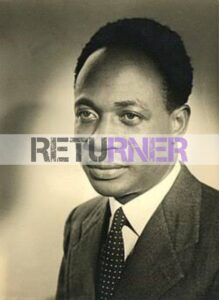
Kwame Nkrumah was born on 21 September 1909 in Nkroful, Gold Coast, which is now Ghana. He grew up in a modest family and attended Achimota School in Accra. His academic journey later took him to the United States, where he studied at Lincoln University and the University of Pennsylvania. He earned degrees in theology, philosophy, and education, and during this time he became deeply influenced by Pan-Africanism and socialist ideas.
He began his career as a teacher and lecturer but soon became active in student politics and Pan-African movements abroad. In 1947, he returned to the Gold Coast and joined the United Gold Coast Convention. His strong leadership and vision led him to break away and form the Convention People’s Party in 1949. His ability to mobilize the masses made him a powerful figure, and even while imprisoned by colonial authorities, he won elections and became Prime Minister in 1952.
Kwame Nkrumah led Ghana to independence on 6 March 1957, becoming the country’s first Prime Minister and later its first President in 1960. He championed African unity and played a key role in founding the Organization of African Unity in 1963. His government initiated major projects, including the Akosombo Dam, which provided hydroelectric power and supported industrial growth. He also promoted education and infrastructure development across Ghana.
His achievements earned him international recognition, including the Lenin Peace Prize in 1962. However, his leadership style was criticized for leaning toward authoritarianism, as he established a one-party state and centralized power. Economic challenges, including falling cocoa prices and ambitious development projects, strained Ghana’s finances.
In 1966, while on a state visit abroad, Nkrumah was overthrown in a military coup. He lived in exile in Guinea, where he was honored as co-president by President Ahmed Sékou Touré. He continued to advocate for African unity until his health declined. He died on 27 April 1972 in Bucharest, Romania, at the age of 62.
Kwame Nkrumah’s legacy remains strong as the man who led Ghana to independence and inspired movements across Africa. He is remembered as a visionary leader, a Pan-Africanist, and a symbol of freedom. His writings, speeches, and policies continue to influence African politics and development. His daughter, Samia Nkrumah, has carried on his political legacy, ensuring that his vision for unity and progress remains alive in Ghana and beyond.
Kwame Nkrumah Formative Experiences and Cultural Foundations
The early life of the man who would lead Ghana to independence began in the small village of Nkroful. Raised in a traditional Nzema household, he was the only child of his mother, a retail trader, while his father worked as a goldsmith. This modest background instilled in him a deep sense of community and the value of hard work. Growing up in the Gold Coast under British colonial rule, he witnessed the social and economic disparities that would later fuel his revolutionary fire. His mother played a crucial role in his development, insisting that he attend a Roman Catholic mission school. These early years in the Western Region were essential in shaping his resilient character. He spent much of his youth navigating the rhythms of rural life, which provided him with a profound understanding of the people he would eventually lead. These foundational experiences created a strong cultural anchor that remained with him throughout his international travels and political ascent.
Kwame Nkrumah Global Academic Journey and Intellectual Growth
The educational path of the future president was both extensive and diverse, spanning three different continents. He began his formal training at Achimota School in Accra, where he qualified as a teacher and was exposed to progressive nationalist ideas. Seeking broader horizons, he moved to the United States to study at Lincoln University, where he earned degrees in economics, sociology, and theology. He continued his scholarship at the University of Pennsylvania, obtaining master’s degrees in education and philosophy. During these years abroad, he supported himself through menial jobs, working as a dishwasher and a dockworker. These hardships did not deter his intellectual pursuits; instead, they deepened his commitment to socialist and Pan-African ideals. His time in the United Kingdom further refined his political thought as he engaged with other African students and activists. This rigorous academic background provided the theoretical framework for his future governance and his vision for a liberated African continent.
Kwame Nkrumah Bold Return and Organizational Leadership Phase
Upon returning to the Gold Coast in 1947, he initially served as the general secretary for the United Gold Coast Convention. However, he soon realized that the existing political structures were too conservative for the radical change he envisioned. This led him to form the Convention People’s Party in 1949, a move that shifted the focus of the independence movement toward the common citizen. He utilized a strategy known as “Positive Action,” which involved non-violent protests, strikes, and civil disobedience against colonial authorities. His ability to mobilize workers, farmers, and market women transformed the political landscape almost overnight. Even when the colonial government imprisoned him, his influence continued to grow, and he famously won a landslide election victory while still behind bars. This period of his career was defined by a tireless commitment to grassroots organizing and an uncompromising demand for “Self-Government Now.” His transition from a political organizer to a national leader was swift and unprecedented.
Kwame Nkrumah Major Accomplishments and Transformational Governance
The leadership of the new nation was marked by ambitious projects aimed at modernizing the country and fostering continental unity. On the historic night of March 6, 1957, he stood at the Black Star Square to declare that Ghana was forever free. One of his most significant domestic achievements was the construction of the Akosombo Dam, which provided the industrial power necessary for national growth. He also prioritized education, introducing free and compulsory primary schooling to empower the next generation. Beyond national borders, he was a driving force behind the establishment of the Organization of African Unity in 1963. His efforts to promote international peace and anti-colonialism earned him the Lenin Peace Prize in 1962. Throughout his presidency, he advocated for a “United States of Africa,” believing that true independence could only be achieved through continental integration. These works solidified his reputation as a visionary leader who looked far beyond the immediate challenges of his own nation.
Kwame Nkrumah Professional Life and Political Philosophy
The professional identity of this statesman was deeply intertwined with his role as a political theorist and revolutionary. He spent his days managing the complex affairs of a newly sovereign state while also writing extensively on the dangers of neo-colonialism. His work environment often shifted from the corridors of power in Accra to international forums where he challenged global superpowers. He promoted a philosophy that combined traditional African values with scientific socialism, a blend he believed was necessary for African progress. His speeches were legendary, often drawing thousands of listeners who were captivated by his vision of a dignified and self-reliant continent. Even while managing the daily operations of the government, he remained a scholar at heart, frequently engaging with other intellectuals and liberation leaders. His professional life was a continuous effort to translate complex political theories into tangible social and economic improvements for his people.
Kwame Nkrumah Family Life and Private Relations
While he was a very public figure, his personal life contained elements of both political strategy and genuine companionship. In 1957, he married Fathia Rizk, an Egyptian Coptic Christian, in a union that was seen as a bridge between North and Sub-Saharan Africa. The couple had three children together: Gamal, Samia, and Sekou, all of whom would later engage with their father’s political legacy. Despite the language barrier between the two—she spoke Arabic and French while he spoke English and Nzema—they formed a strong domestic bond. His family life was often complicated by the intense demands of his presidency and the constant threats to his security. After his overthrow, his wife and children were forced to seek refuge in Egypt while he lived in exile. Nevertheless, his children have often spoken of the profound impact his ideals had on their upbringing. His role as a father and husband remained a vital, if often overshadowed, aspect of his complex life.
Kwame Nkrumah Political Setbacks and Forced Departure
The latter years of his presidency were marred by increasing internal and external pressures that eventually led to his downfall. Economic difficulties, exacerbated by falling cocoa prices and the high costs of industrial projects, created social unrest among the population. His government became increasingly authoritarian, implementing the Preventive Detention Act to suppress political opposition and declaring a one-party state. These actions, intended to maintain stability, instead alienated many of his former supporters and the military elite. On February 24, 1966, while he was on a peace mission to Hanoi, a military coup d’état successfully toppled his administration. This event marked a tragic end to his active governance and forced him into a life of exile in Guinea. He spent his remaining years in Conakry, continueing to write and advocate for African unity but never again setting foot on Ghanaian soil. This period remains a subject of intense debate among historians regarding the factors that led to his removal.
Kwame Nkrumah Enduring Legacy and Global Significance
The impact of this revolutionary leader extends far beyond his physical life and the borders of the nation he founded. He passed away in 1972 in Bucharest, Romania, but his ideas continue to resonate across the African continent and the global diaspora. He is remembered as the “Osagyefo,” a redeemer who broke the chains of colonial rule and inspired a generation of freedom fighters. His writings on neo-colonialism and Pan-Africanism are still studied in universities worldwide as foundational texts of African political thought. Today, he is honored with a grand memorial park in Accra, where his remains are interred, serving as a site of pilgrimage for those who value African independence. His vision of a united and prosperous Africa remains a guiding light for modern institutions like the African Union. He has been voted the “African of the Millennium” by international audiences, a testament to his lasting influence. His life story serves as a reminder of the power of a bold vision to change the course of history.
Kwame Nkrumah Age (Biological Lifespan and Historical Timeframes)
Kwame Nkrumah was born on September 21, 1909. At the time of his passing on April 27, 1972, he was 62 years old. This recorded Kwame Nkrumah age reflects his lifespan from his birth in Nkroful to his death in Bucharest.
Kwame Nkrumah Wife (Matrimonial Bonds and Personal Partnerships)
Kwame Nkrumah was married to Fathia Rizk, who was originally from Egypt. She was born Fathia Halim Rizk and belonged to a Coptic Christian family. Their marriage took place in late 1957 following her arrival in Ghana. Fathia Rizk served as the first First Lady of the Republic of Ghana.
Kwame Nkrumah Cause of Death (Medical Circumstances and Final Health Records)
Kwame Nkrumah died of prostate cancer on April 27, 1972. This medical condition resulted in his passing while he was receiving treatment in Bucharest, Romania. While some historical accounts mention skin or lung cancer, medical records and mainstream biographies identify prostate cancer as the primary cause. This specific illness led to his death at the age of 62 while in exile.
Kwame Nkrumah Religion (Spiritual Affiliations and Faith Based Beliefs)
Kwame Nkrumah was baptized as a Roman Catholic and educated within the Catholic mission school system. He formally described his personal spiritual orientation as that of a “non-denominational Christian and a Marxist socialist.” This identification reflected his academic background in theology and his efforts to harmonize religious ethics with political theory. He maintained a strong belief in a supreme source of power in the universe while explicitly rejecting the structures of organized religion.
Kwame Nkrumah Children (Immediate Offspring and Family Lineage Overview)
Kwame Nkrumah was the father of four children. His children include Francis Nkrumah from an earlier relationship and three children with his wife Fathia Rizk named Gamal, Samia, and Sekou Nkrumah. These descendants have pursued varied careers in medicine, journalism, and politics within and outside of Ghana. Information regarding his children focuses on these four specific individuals as his recognized offspring.
Kwame Nkrumah Profile Table (Quick Reference Data and Biographical Summary)
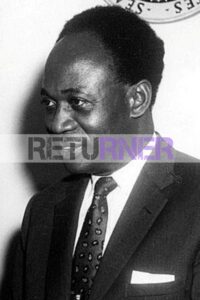
| Profile | Information |
| Kwame Nkrumah career | Politician, revolutionary, and political theorist |
| Kwame Nkrumah real name | Francis Nwia-Kofi Ngonloma |
| Kwame Nkrumah age | 62 years (at time of death) |
| Kwame Nkrumah date of birth | September 21, 1909 |
| Kwame Nkrumah net worth | Not known |
| Kwame Nkrumah wife / spouse | Fathia Rizk |
| Kwame Nkrumah children | Francis Nkrumah, Gamal Nkrumah, Samia Nkrumah, Sekou Nkrumah |
| Kwame Nkrumah parents | Kofi Ngonloma (Father) and Elizabeth Nyaniba (Mother) |
| Kwame Nkrumah religion | Non-denominational Christian |
| Kwame Nkrumah state of origin | Western Region, Gold Coast (now Ghana) |
| Kwame Nkrumah alma mater | Lincoln University and University of Pennsylvania |
| Kwame Nkrumah education | BA and BTh from Lincoln University; MA and MS from University of Pennsylvania |
| Kwame Nkrumah nationality | Ghanaian |
Leave a Reply